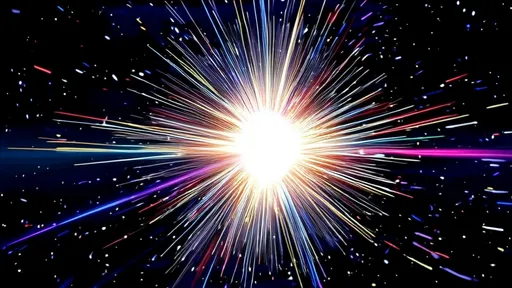
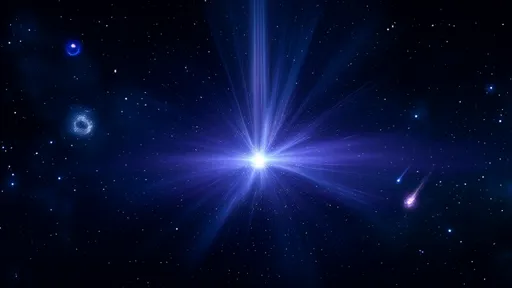
The universe as we know it began with an event so cataclysmic that its echoes still reverberate through the fabric of space and time. The Big Bang theory, the prevailing cosmological model, describes the birth of the cosmos from an infinitely dense and hot singularity approximately 13.8 billion years ago. This singular moment marked not just the beginning of matter and energy but also the very dimensions of space and time themselves. The implications of this theory stretch far beyond mere astrophysics—it reshapes our understanding of existence, causality, and the fundamental nature of reality.
In the immediate aftermath of the Big Bang, the universe was a seething, opaque plasma of particles and radiation. There were no atoms, no molecules, and certainly no stars or galaxies. The temperature was so unimaginably high that even the fundamental forces we take for granted—gravity, electromagnetism, and the nuclear forces—were unified into a single, indistinguishable interaction. As the universe expanded and cooled, these forces began to separate, triggering a cascade of phase transitions that would set the stage for the formation of matter as we know it.
The first few microseconds were particularly critical. During this period, a process known as baryogenesis may have occurred, creating the slight imbalance between matter and antimatter that allowed our universe to be dominated by matter. Without this asymmetry, all particles would have annihilated with their antiparticle counterparts, leaving behind a sterile sea of radiation. The fact that we exist at all is a testament to this mysterious and still poorly understood preference for matter over antimatter in the early universe.
As the cosmos continued to expand, it cooled enough for quarks to combine into protons and neutrons, the building blocks of atomic nuclei. About 380,000 years after the Big Bang, the universe had cooled sufficiently for electrons to combine with these nuclei, forming the first neutral atoms. This epoch, known as recombination, allowed photons to travel freely for the first time, creating the cosmic microwave background radiation—a faint glow that permeates the entire universe and serves as a snapshot of the infant cosmos.
The cosmic microwave background is perhaps the most compelling evidence for the Big Bang theory. Discovered accidentally in 1965 by Arno Penzias and Robert Wilson, this radiation exhibits an almost perfect blackbody spectrum with tiny temperature fluctuations that correspond to density variations in the early universe. These minute irregularities, observed with increasing precision by satellites like COBE, WMAP, and Planck, were the seeds from which all large-scale structures—galaxies, clusters, and superclusters—would eventually grow.
Gravity played the starring role in transforming these primordial density fluctuations into the rich tapestry of the cosmos we observe today. Over hundreds of millions of years, slightly denser regions attracted more matter through gravitational attraction, growing ever larger and hotter until nuclear fusion ignited in their cores, giving birth to the first stars. These Population III stars, composed almost entirely of hydrogen and helium, were likely massive and short-lived, ending their lives in spectacular supernovae that forged heavier elements and enriched the interstellar medium.
The formation of galaxies represents another critical chapter in cosmic evolution. Current theories suggest that dark matter—an invisible form of matter that interacts only through gravity—provided the scaffolding upon which ordinary matter could accumulate. The Milky Way, our cosmic home, began taking shape about 13 billion years ago through the mergers of smaller protogalaxies. Each galactic collision and merger left its imprint on the structure and stellar populations we observe today, creating the diverse array of galaxy types that populate the universe.
Dark energy, the mysterious force driving the accelerated expansion of the universe, adds another layer of complexity to our cosmic story. Discovered in the late 1990s through observations of distant supernovae, dark energy appears to be counteracting gravity on the largest scales, causing galaxies to recede from one another at ever-increasing speeds. Its nature remains one of the greatest unsolved problems in physics, with profound implications for the ultimate fate of the universe.
The Big Bang theory continues to evolve as new observations challenge and refine our understanding. The precise measurement of the Hubble constant—the rate of cosmic expansion—has revealed a troubling discrepancy between early universe measurements and observations of nearby galaxies. This "Hubble tension" suggests there may be gaps in our knowledge of fundamental physics or the composition of the universe. Similarly, the nature of dark matter remains elusive despite decades of experimental searches, prompting some physicists to consider modifications to the laws of gravity itself.
Looking ahead, next-generation telescopes like the James Webb Space Telescope and the Vera C. Rubin Observatory promise to peer even further back in time, potentially revealing the very first galaxies and shedding light on the so-called "cosmic dawn." Meanwhile, experiments attempting to detect dark matter particles or measure gravitational waves from the earliest moments of the universe could revolutionize our understanding of cosmic origins.
The Big Bang theory represents humanity's most comprehensive attempt to answer age-old questions about our place in the cosmos. From an infinitely dense singularity to the vast, structured universe we inhabit today, this scientific narrative connects the microscopic world of quantum physics with the macroscopic realm of galaxies and clusters. Yet for all its successes, the theory leaves many questions unanswered, reminding us that the pursuit of cosmic understanding is an ongoing journey rather than a final destination.
By /Jun 20, 2025
By /Jun 20, 2025
By /Jun 20, 2025

By /Jun 19, 2025

By /Jun 19, 2025
By /Jun 19, 2025

By /Jun 19, 2025
By /Jun 19, 2025
By /Jun 19, 2025
By /Jun 19, 2025
By /Jun 19, 2025

By /Jun 19, 2025

By /Jun 19, 2025
By /Jun 19, 2025
By /Jun 19, 2025
By /Jun 19, 2025

By /Jun 19, 2025
