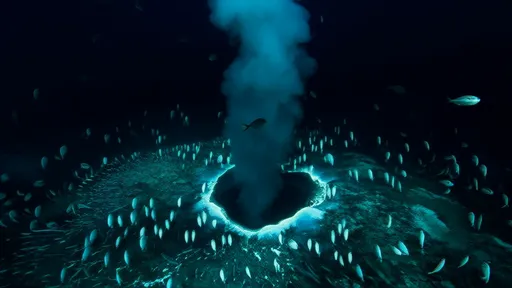
In the perpetual darkness of the ocean’s abyss, where sunlight cannot penetrate and pressures crush all but the most resilient, life thrives in ways that defy conventional understanding. Deep-sea hydrothermal vents, often called "black smokers," spew superheated, mineral-rich fluids into the frigid water, creating oases of life in an otherwise barren landscape. These otherworldly ecosystems are sustained not by photosynthesis, but by chemosynthesis—a process where microbes convert toxic chemicals into energy, forming the foundation of a food web that supports an array of bizarre and fascinating creatures.
The discovery of hydrothermal vent ecosystems in 1977 shattered long-held assumptions about life’s requirements. Before then, scientists believed all life depended on the sun’s energy, funneled through photosynthesis. Yet here, in the crushing depths of the Galápagos Rift, were thriving communities of giant tube worms, blind shrimp, and ghostly white crabs—all flourishing in complete darkness. The key to their survival lies in the vents’ geochemistry. Seawater percolates through cracks in the Earth’s crust, heating to extremes before re-emerging laden with hydrogen sulfide, methane, and dissolved metals. Bacteria and archaea harness these chemicals, producing organic matter that feeds the entire ecosystem.
At the heart of these communities are the symbiotic relationships that allow larger organisms to survive. The giant tube worm (Riftia pachyptila), for example, lacks a mouth or digestive system. Instead, it houses chemosynthetic bacteria in a specialized organ called the trophosome. The worm’s red plume absorbs hydrogen sulfide and oxygen from the water, which the bacteria use to produce nutrients for their host. Similarly, vent clams and mussels host bacteria in their gills, while yeti crabs "farm" bacteria on their hairy claws, scraping them off to eat. These intricate partnerships highlight evolution’s ingenuity in exploiting even the harshest environments.
The extreme conditions around hydrothermal vents—temperatures exceeding 400°C, acidity levels capable of dissolving metal, and toxic chemical cocktails—make them one of Earth’s most hostile habitats. Yet life not only persists here; it thrives. The vents are biodiversity hotspots, with species found nowhere else on the planet. Many are relics of ancient lineages, offering glimpses into early evolutionary pathways. Their survival strategies—such as proteins resistant to heat denaturation or enzymes that detoxify sulfur—have attracted biotech researchers seeking extremophile adaptations for industrial applications.
Hydrothermal vents are also fleeting landscapes, their chimneys growing and collapsing over decades. When a vent goes dormant, its community faces extinction unless larvae can colonize a new site. This impermanence has driven species to develop remarkable dispersal mechanisms. Some vent animals release buoyant larvae that drift for miles on currents, while others migrate actively between vent fields. Scientists have even discovered "vent hopping" species, like the scaly-foot snail, whose iron-coated shell protects it during journeys across the abyssal plain.
Beyond their biological marvels, these systems reshape our understanding of life’s potential. The discovery of chemosynthesis suggested that life could exist in similar environments elsewhere in the solar system—perhaps in the subsurface oceans of Europa or Enceladus. On Earth, hydrothermal vents may have been the crucibles where life first emerged, their mineral-rich fluids providing the energy and raw materials for early biochemical reactions. Each new vent explored reveals previously unknown species and metabolic tricks, underscoring how much remains to be learned about these deep-sea enigmas.
Yet these ecosystems face growing threats from human activities. Deep-sea mining operations target vent deposits for rare metals, risking irreversible damage to fragile vent communities. Climate change, too, may alter ocean circulation patterns that disperse vent larvae. Protecting these habitats requires international cooperation, as vents lie beyond national jurisdictions. Their study not only satisfies scientific curiosity but also reminds us of life’s tenacity—and the responsibility to preserve its most extraordinary manifestations.
In the eternal night of the deep ocean, hydrothermal vents stand as testament to nature’s creativity. They challenge our definitions of habitability, inspire technological innovation, and may hold clues to life’s origins. As submersibles probe deeper and genetic tools unravel microbial mysteries, each expedition into this realm brings new revelations. These shimmering, mineral-laden towers, surrounded by swirling clouds of life, are more than geological oddities—they are beacons illuminating the resilience and diversity of life on Earth.
By /Jun 20, 2025

By /Jun 20, 2025

By /Jun 20, 2025
By /Jun 19, 2025

By /Jun 19, 2025

By /Jun 19, 2025

By /Jun 19, 2025

By /Jun 19, 2025

By /Jun 19, 2025

By /Jun 19, 2025

By /Jun 19, 2025
By /Jun 19, 2025

By /Jun 19, 2025
By /Jun 19, 2025

By /Jun 19, 2025

By /Jun 19, 2025

By /Jun 19, 2025
