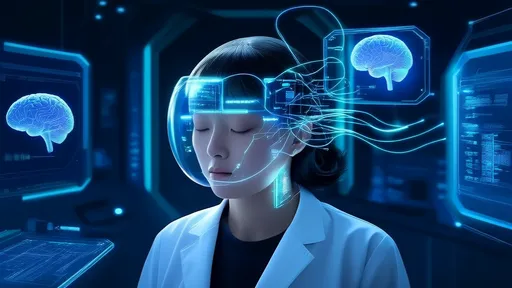
The human brain has long served as the ultimate inspiration for computational models seeking to replicate its remarkable capabilities. Artificial neural networks (ANNs) represent one of the most successful attempts at creating algorithmic systems that mirror the brain's fundamental operational principles. These sophisticated mathematical constructs have revolutionized fields ranging from computer vision to natural language processing, demonstrating an uncanny ability to learn patterns and make decisions in ways that increasingly resemble biological cognition.
At their core, neural networks embody a simplified version of how neuroscientists understand biological neurons to function. Just as the brain consists of interconnected neurons that transmit signals through synapses, ANNs are built from layers of artificial neurons that pass numerical information through weighted connections. This architectural similarity allows neural networks to approximate the brain's pattern recognition prowess, albeit without matching its energy efficiency or the sheer complexity of human neural circuitry.
The journey of artificial neural networks began in the mid-20th century with pioneering work by researchers like Warren McCulloch and Walter Pitts. Their 1943 paper proposed the first mathematical model of a neuron, laying the conceptual foundation for all subsequent developments. What began as simple perceptrons capable of basic linear classification has evolved into today's deep learning architectures containing billions of parameters. This evolution mirrors our growing understanding of both neurobiology and computational theory.
Modern neural networks typically organize their artificial neurons into multiple layers - an input layer that receives data, hidden layers that process information, and an output layer that produces results. Each connection between neurons carries a weight that determines its influence, and these weights adjust automatically during training through backpropagation. This process, analogous to how synaptic strengths change during learning in biological systems, allows ANNs to improve their performance over time without explicit programming.
One of the most striking parallels between artificial and biological neural networks lies in their distributed representation of information. In the brain, memories and concepts aren't stored in single neurons but rather emerge from patterns of activation across many interconnected cells. Similarly, ANNs encode learned information across their weights and activations, creating representations that often prove remarkably robust to noise and partial information. This distributed approach contributes to both systems' ability to generalize from examples.
The success of deep neural networks in particular has reinforced the value of hierarchical processing - another principle borrowed from neuroscience. Just as the visual cortex processes visual information through successive areas that extract increasingly complex features, deep learning architectures build up representations through multiple layers of abstraction. Early layers might detect simple edges or textures, while deeper layers combine these into more sophisticated patterns corresponding to objects or concepts.
Despite these similarities, important differences remain between artificial neural networks and their biological counterparts. The brain's neurons communicate through complex electrochemical processes involving not just firing rates but also precise spike timing, neurotransmitter dynamics, and intricate feedback mechanisms. Current ANNs vastly simplify these biological details, focusing primarily on the mathematical essence of weighted connections and activation thresholds. This abstraction has proven remarkably powerful for practical applications while remaining computationally tractable.
Another key distinction lies in the training process. Biological brains learn continuously through experience, consolidating memories during sleep, and adapting to new situations with remarkable flexibility. Artificial neural networks typically undergo discrete training phases on curated datasets, though researchers are making progress toward more lifelong learning approaches. The brain's energy efficiency - operating on about 20 watts compared to the massive computational resources required for large neural networks - remains another area where biological systems far surpass their artificial counterparts.
The relationship between artificial neural networks and neuroscience has become increasingly symbiotic. As ANNs grow more sophisticated, they provide testable models for neuroscientific theories. Conversely, new discoveries about brain function often inspire novel neural network architectures. This cross-pollination has led to innovations like attention mechanisms, which mimic how biological systems allocate cognitive resources, and spiking neural networks that incorporate temporal dynamics closer to actual neuron behavior.
Looking forward, the interplay between artificial intelligence and neuroscience promises to deepen our understanding of both fields. Researchers are exploring how principles from developmental neuroscience might inform more efficient learning algorithms, and how insights from cognitive science could lead to neural networks with better reasoning abilities. The ultimate goal isn't merely to create tools that solve practical problems, but to unravel the fundamental principles of intelligence itself - whether biological or artificial.
As artificial neural networks continue their rapid advancement, they simultaneously serve as powerful engineering tools and as simplified models for understanding the most complex information processing system we know - the human brain. This dual role ensures that the study of ANNs will remain at the forefront of both computer science and neuroscience for years to come. The convergence of these disciplines may eventually answer some of the most profound questions about the nature of intelligence, consciousness, and the very mechanisms of thought.
By /Jun 20, 2025
By /Jun 20, 2025

By /Jun 20, 2025

By /Jun 19, 2025

By /Jun 19, 2025
By /Jun 19, 2025
By /Jun 19, 2025

By /Jun 19, 2025
By /Jun 19, 2025

By /Jun 19, 2025

By /Jun 19, 2025

By /Jun 19, 2025
By /Jun 19, 2025
By /Jun 19, 2025
By /Jun 19, 2025

By /Jun 19, 2025
By /Jun 19, 2025
