Carbon Cycle in Ecosystems: The Material Flow Chain from Atmosphere to Organisms

Jun 20, 2025 By

The intricate dance of carbon through Earth's ecosystems represents one of nature's most elegant balancing acts. From the air we breathe to the wood of ancient trees, carbon atoms embark on remarkable journeys that sustain life while maintaining atmospheric equilibrium. This perpetual cycling connects all living organisms through an invisible web of matter and energy exchange that has shaped our planet for billions of years.

Atmospheric carbon dioxide forms the starting point for this planetary-scale phenomenon. Each spring, as sunlight intensifies across hemispheres, a visible greening occurs as vegetation awakens from dormancy. This seasonal pulse demonstrates photosynthesis in action - that miraculous biochemical process where plants, algae and cyanobacteria transform gaseous CO₂ into solid biological matter. Through this alchemy of life, carbon becomes incorporated into stems, leaves, roots and reproductive structures, building the physical architecture of ecosystems.

The transfer of carbon from producers to consumers creates cascading flows through food webs. Herbivores incorporate plant carbon into muscle and bone, while predators subsequently acquire these atoms through consumption. At each trophic level, respiration returns a portion of carbon to the atmosphere as CO₂, creating a constant cycling between organic and inorganic states. This biological pump operates continuously across forests, grasslands, wetlands and aquatic systems, with varying efficiencies depending on ecosystem type and climatic conditions.

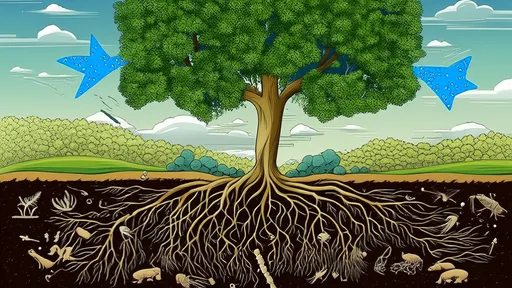
Below ground, an equally vital carbon exchange occurs through symbiotic relationships between plant roots and soil microorganisms. Mycorrhizal fungi form extensive networks that can account for up to one-third of living biomass in forest soils. These fungal partners enhance nutrient acquisition for plants while receiving carbon compounds in return. The delicate balance of this underground economy influences how much carbon remains sequestered in soils versus re-entering atmospheric circulation.

Disturbances like wildfires or timber harvesting can abruptly alter carbon flow trajectories. Combustion rapidly oxidizes organic matter, releasing centuries of accumulated carbon in mere hours. However, these events also create conditions for new growth, initiating another cycle of carbon fixation. The interplay between gradual accumulation and sudden release creates dynamic equilibrium states that have maintained atmospheric CO₂ within habitable ranges throughout most of Earth's history - until recent anthropogenic disruptions.

Aquatic systems participate equally in global carbon cycling, though through different mechanisms. Surface waters absorb atmospheric CO₂, while marine phytoplankton perform approximately half of planetary photosynthesis. The biological pump transports carbon to deep ocean reservoirs as organisms die and sink, with some fraction becoming sequestered in sediments. Coastal wetlands demonstrate particularly efficient long-term storage, accumulating organic matter in oxygen-deprived soils where decomposition proceeds slowly.

Climate change has introduced unprecedented variables into these ancient cycling patterns. Rising temperatures accelerate decomposition in boreal peatlands, releasing carbon stocks accumulated over millennia. Ocean acidification alters marine carbonate chemistry, potentially disrupting shell-forming organisms that play key roles in marine carbon transport. These perturbations risk transforming carbon sinks into sources, creating feedback loops that could further amplify atmospheric changes.

Understanding these interconnected flows has never been more critical. The same carbon atoms that currently compose atmospheric greenhouse gases may tomorrow become part of a redwood's trunk or a krill's exoskeleton. How human societies manage these transitions - through conservation, restoration or technological interventions - will determine whether Earth's carbon cycle can reestablish equilibrium or face permanent alteration. The decisions we make about forests, agriculture and energy systems ultimately influence the fate of these elemental journeys that underpin all life.
Recommend Posts
Science

Carbon Cycle in Ecosystems: The Material Flow Chain from Atmosphere to Organisms

By /Jun 20, 2025

The intricate dance of carbon through Earth's ecosystems represents one of nature's most elegant balancing acts. From the air we breathe to the wood of ancient trees, carbon atoms embark on remarkable journeys that sustain life while maintaining atmospheric equilibrium. This perpetual cycling connects all living organisms through an invisible web of matter and energy exchange that has shaped our planet for billions of years.
Science

Doppler Effect: The Mystery of Frequency Changes in Sound and Light

By /Jun 20, 2025

The Doppler effect is one of those fascinating phenomena that we encounter in our daily lives without always realizing it. Whether it’s the changing pitch of a passing ambulance siren or the redshift observed in distant galaxies, this principle governs how waves—be they sound or light—behave when there’s relative motion between the source and the observer. The implications stretch far beyond simple observations, influencing fields as diverse as astronomy, medicine, and even traffic control.
Science

The Big Bang: A Scientific Explanation of the Origin of Everything

By /Jun 20, 2025

The universe as we know it began with an event so cataclysmic that its echoes still reverberate through the fabric of space and time. The Big Bang theory, the prevailing cosmological model, describes the birth of the cosmos from an infinitely dense and hot singularity approximately 13.8 billion years ago. This singular moment marked not just the beginning of matter and energy but also the very dimensions of space and time themselves. The implications of this theory stretch far beyond mere astrophysics—it reshapes our understanding of existence, causality, and the fundamental nature of reality.
Science

Artificial Photosynthesis: Simulating Solar Energy Conversion in the Lab

By /Jun 19, 2025

In the quiet hum of laboratories around the world, scientists are bending light to their will, attempting to replicate one of nature’s most elegant feats: photosynthesis. For decades, the dream of artificial photosynthesis has tantalized researchers, offering the promise of clean energy harnessed directly from sunlight, much like plants have done for millions of years. But where plants effortlessly convert sunlight, water, and carbon dioxide into oxygen and glucose, human-made systems have struggled to match this efficiency. Recent breakthroughs, however, suggest that the gap may finally be narrowing.
Science

Topological Data Analysis: Geometric Approaches to Unraveling the Structure of Complex Datasets

By /Jun 19, 2025

In the age of big data, traditional statistical methods often struggle to capture the intricate structures hidden within vast and high-dimensional datasets. Enter topological data analysis (TDA), a revolutionary approach that borrows concepts from algebraic topology to uncover the shape and connectivity of data. Unlike conventional techniques that focus on metrics like mean or variance, TDA treats data as a geometric object, revealing holes, clusters, and persistent features that persist across multiple scales. This paradigm shift is transforming fields ranging from genomics to finance, offering insights that were previously invisible to analysts.
Science

Neurodegenerative Diseases: Brain Pathologies Triggered by Protein Misfolding

By /Jun 19, 2025

The human brain, a marvel of biological engineering, remains vulnerable to insidious processes that gradually erode its function. Among the most perplexing and devastating of these are neurodegenerative diseases, where the very building blocks of neurons – proteins – turn against the intricate machinery they once supported. At the heart of this betrayal lies a fundamental biological flaw: protein misfolding, a process where molecules crucial for cellular function twist into malignant shapes, triggering cascades of destruction.
Science

Performance of Carbon Nanotubes: The Mechanical and Electrical Wonders of One-Dimensional Nanomaterials

By /Jun 19, 2025

The world of nanomaterials has witnessed a revolution with the discovery and development of carbon nanotubes (CNTs). These one-dimensional nanostructures, composed of rolled-up graphene sheets, have captivated researchers and engineers alike with their extraordinary mechanical and electrical properties. Unlike any other material known to man, carbon nanotubes combine strength, flexibility, and conductivity in ways that defy conventional material science paradigms.
Science

Cosmic Ray Origin: The Mystery of High-Energy Particle Acceleration Across the Interstellar Medium

By /Jun 19, 2025

The universe is a vast and mysterious place, filled with phenomena that challenge our understanding of physics. Among the most enigmatic of these are cosmic rays—high-energy particles that travel through space at nearly the speed of light. Their origins have puzzled scientists for over a century, and despite significant advances in astrophysics, the mechanisms behind their acceleration remain one of the great unsolved mysteries of modern science.
Science

Molecular Switches of Stem Cell Differentiation: The Destiny Determination of Totipotent Cells

By /Jun 19, 2025

In the intricate dance of embryonic development, totipotent stem cells hold a unique position as the ultimate architects of life. These remarkable cells, capable of giving rise to an entire organism, make fate-determining decisions through an exquisitely tuned molecular symphony. Recent breakthroughs have begun to unravel the complex regulatory networks that serve as biological switches, directing these master cells toward their ultimate destinies.
Science

Magnetic Confinement Fusion: The Quest for Artificial Sun in Tokamak Devices

By /Jun 19, 2025

The quest for harnessing the power of the stars has long captivated scientists and engineers, and at the forefront of this endeavor lies the tokamak—a donut-shaped chamber designed to replicate the fusion processes that fuel our sun. Magnetic confinement fusion, the principle behind tokamaks, offers a tantalizing glimpse into a future of nearly limitless, clean energy. Unlike traditional nuclear fission, which splits atoms and produces long-lived radioactive waste, fusion combines light atomic nuclei, releasing vast amounts of energy with minimal environmental impact. The tokamak, with its intricate magnetic fields, stands as humanity’s most promising tool to achieve this dream.
Science

Riemann Hypothesis: The Century-Old Unsolved Problem of Prime Number Distribution Law

By /Jun 19, 2025

The Riemann Hypothesis, often described as the holy grail of mathematics, has remained one of the most profound unsolved problems for over a century. Proposed by the German mathematician Bernhard Riemann in 1859, this conjecture delves into the enigmatic distribution of prime numbers—those indivisible integers that serve as the building blocks of all numbers. Despite countless attempts by the brightest minds in mathematics, the hypothesis continues to resist proof, standing as a testament to the complexity and beauty of number theory.
Science

Deep-Sea Hydrothermal Vent Ecosystem: An Oasis of Life Relying on Chemical Energy in the Darkness

By /Jun 19, 2025

In the perpetual darkness of the ocean’s abyss, where sunlight cannot penetrate and pressures crush all but the most resilient, life thrives in ways that defy conventional understanding. Deep-sea hydrothermal vents, often called "black smokers," spew superheated, mineral-rich fluids into the frigid water, creating oases of life in an otherwise barren landscape. These otherworldly ecosystems are sustained not by photosynthesis, but by chemosynthesis—a process where microbes convert toxic chemicals into energy, forming the foundation of a food web that supports an array of bizarre and fascinating creatures.
Science

Artificial Neural Networks: Algorithmic Models Emulating the Working Principles of the Brain

By /Jun 19, 2025

The human brain has long served as the ultimate inspiration for computational models seeking to replicate its remarkable capabilities. Artificial neural networks (ANNs) represent one of the most successful attempts at creating algorithmic systems that mirror the brain's fundamental operational principles. These sophisticated mathematical constructs have revolutionized fields ranging from computer vision to natural language processing, demonstrating an uncanny ability to learn patterns and make decisions in ways that increasingly resemble biological cognition.
Science

Protein Folding Code: The Folding Enigma from Amino Acid Chain to Functional Structure

By /Jun 19, 2025

The intricate dance of protein folding represents one of biology's most captivating mysteries. For decades, scientists have sought to decipher the hidden code that transforms a linear sequence of amino acids into a perfectly functional three-dimensional structure. This process, fundamental to all life, holds the key to understanding diseases, designing novel therapeutics, and unlocking nature's architectural blueprints.
Science

Ultracold Atom Physics: Control of Quantum States Near Absolute Zero

By /Jun 19, 2025

In the realm of quantum physics, few frontiers are as tantalizing as the study of ultracold atoms. By cooling atoms to temperatures just a hair's breadth above absolute zero, scientists unlock bizarre and fascinating states of matter that defy classical intuition. These extreme conditions reveal quantum behaviors on macroscopic scales, offering a playground for probing fundamental physics and developing revolutionary technologies.
Science

Exoplanet Atmosphere Analysis: Spectral Fingerprints for the Search of Extraterrestrial Life

By /Jun 19, 2025

The search for life beyond Earth has entered a revolutionary phase with the advent of advanced spectroscopic techniques applied to exoplanetary atmospheres. As astronomers peer into the chemical compositions of distant worlds, they are hunting for spectral fingerprints—unique molecular signatures that could indicate the presence of biological activity. This pursuit is no longer confined to science fiction; it is a rigorous scientific endeavor reshaping our understanding of life’s potential in the cosmos.
Science

Brain-Computer Interface Technology: Direct Dialogue Between Neural Signals and Electronic Devices

By /Jun 19, 2025

In a world where technology continues to push the boundaries of human capability, brain-computer interfaces (BCIs) stand at the forefront of innovation. These systems, which facilitate direct communication between neural signals and electronic devices, are no longer confined to the realm of science fiction. From medical breakthroughs to futuristic consumer applications, BCIs are reshaping how we interact with machines—and even each other.