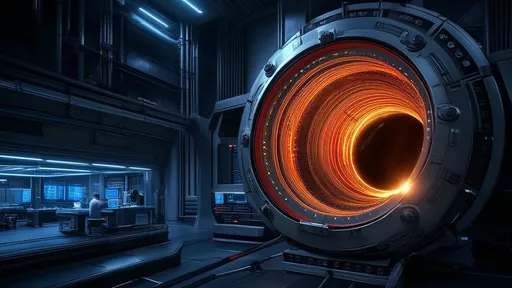
The quest for harnessing the power of the stars has long captivated scientists and engineers, and at the forefront of this endeavor lies the tokamak—a donut-shaped chamber designed to replicate the fusion processes that fuel our sun. Magnetic confinement fusion, the principle behind tokamaks, offers a tantalizing glimpse into a future of nearly limitless, clean energy. Unlike traditional nuclear fission, which splits atoms and produces long-lived radioactive waste, fusion combines light atomic nuclei, releasing vast amounts of energy with minimal environmental impact. The tokamak, with its intricate magnetic fields, stands as humanity’s most promising tool to achieve this dream.
The heart of a tokamak’s operation lies in its ability to confine superheated plasma—a state of matter where electrons are stripped from atoms, creating a swirling, electrically conductive gas. To sustain fusion reactions, this plasma must reach temperatures exceeding 100 million degrees Celsius, far hotter than the core of the sun. Containing such extreme conditions is no small feat; any contact with the reactor walls would instantly cool the plasma and halt the reaction. This is where the tokamak’s magnetic fields come into play. By generating powerful toroidal and poloidal magnetic fields, the device creates an invisible cage that keeps the plasma suspended and stable within the vacuum chamber.
Recent advancements in tokamak technology have brought the dream of practical fusion energy closer than ever. Projects like ITER (International Thermonuclear Experimental Reactor), a collaboration among 35 nations, aim to demonstrate the feasibility of sustained fusion reactions. ITER’s massive scale—its plasma chamber will stand nearly 30 meters tall—highlights the engineering challenges involved. Yet, even as ITER progresses, smaller tokamaks like China’s EAST and the UK’s MAST-U are making breakthroughs in plasma stability and energy efficiency. These experiments are critical stepping stones, proving that the physics of fusion can be tamed.
One of the most persistent hurdles in tokamak research is achieving plasma stability. Turbulence within the plasma can lead to disruptions—sudden collapses of the magnetic confinement that release bursts of energy capable of damaging the reactor. Scientists employ sophisticated diagnostics and control systems to monitor and adjust the plasma in real-time. Techniques like resonant magnetic perturbations and pellet injection have shown promise in mitigating these instabilities. Meanwhile, advancements in superconducting magnets, which consume less power than conventional copper coils, are making tokamaks more energy-efficient and economically viable.
The environmental promise of fusion energy is undeniable. A fusion reactor would produce no greenhouse gases, and its primary byproduct—helium—is inert and non-toxic. Unlike fission reactors, fusion carries no risk of meltdowns or proliferation of weapons-grade materials. However, the road to commercialization remains long. Even optimistic projections suggest that fusion power plants won’t be operational until the latter half of this century. The challenges are immense: from materials capable of withstanding neutron bombardment to the development of tritium breeding blankets that can fuel the reactor sustainably.
Despite these obstacles, the global fusion community remains undeterred. Private companies like Commonwealth Fusion Systems and TAE Technologies are racing to build compact tokamaks and alternative fusion devices, leveraging innovations in high-temperature superconductors and plasma physics. Governments, too, are increasing investments, recognizing fusion’s potential to address both energy security and climate change. The tokamak, once a theoretical curiosity, now stands as a beacon of hope—a testament to human ingenuity and our unyielding pursuit of a brighter, cleaner future.
As research continues, the tokamak’s story is far from over. Each experiment, whether a triumphant success or a humbling setback, brings new insights into the complexities of plasma behavior and magnetic confinement. The lessons learned today will shape the reactors of tomorrow, bringing us ever closer to the day when the power of the sun can be summoned here on Earth. For now, the tokamak remains our best shot at unlocking the secrets of fusion—a challenge as daunting as it is inspiring.

By /Jun 20, 2025

By /Jun 20, 2025
By /Jun 20, 2025
By /Jun 19, 2025

By /Jun 19, 2025

By /Jun 19, 2025
By /Jun 19, 2025

By /Jun 19, 2025
By /Jun 19, 2025
By /Jun 19, 2025
By /Jun 19, 2025
By /Jun 19, 2025

By /Jun 19, 2025
By /Jun 19, 2025
By /Jun 19, 2025
By /Jun 19, 2025

By /Jun 19, 2025
