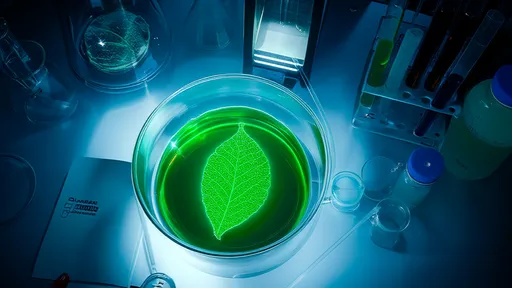
In the quiet hum of laboratories around the world, scientists are bending light to their will, attempting to replicate one of nature’s most elegant feats: photosynthesis. For decades, the dream of artificial photosynthesis has tantalized researchers, offering the promise of clean energy harnessed directly from sunlight, much like plants have done for millions of years. But where plants effortlessly convert sunlight, water, and carbon dioxide into oxygen and glucose, human-made systems have struggled to match this efficiency. Recent breakthroughs, however, suggest that the gap may finally be narrowing.
The concept of artificial photosynthesis is deceptively simple. By mimicking the natural process, scientists aim to create devices that can absorb sunlight and use its energy to split water into hydrogen and oxygen or convert carbon dioxide into usable fuels like methane or methanol. The implications are staggering. Such technology could provide a renewable, carbon-neutral energy source, addressing both the climate crisis and the world’s insatiable energy demands. Yet, the path from theory to practical application has been fraught with challenges, from finding the right materials to engineering systems that can operate at scale.
One of the most promising developments in this field has been the use of advanced catalysts to drive the necessary chemical reactions. In nature, enzymes like photosystem II play a crucial role in splitting water during photosynthesis. Researchers have spent years trying to design synthetic catalysts that can perform a similar function without degrading under the harsh conditions of sunlight and water. Recent strides in molecular engineering have yielded catalysts based on abundant metals like cobalt and nickel, which are not only efficient but also far cheaper than the precious metals traditionally used.
Another critical hurdle has been the design of light-absorbing materials. Plants use chlorophyll to capture sunlight, but artificial systems require materials that can absorb a broader spectrum of light and convert it into energy with minimal loss. Perovskites, a class of materials with a unique crystalline structure, have emerged as a frontrunner in this regard. Their ability to absorb light across a wide range of wavelengths, coupled with their relatively low production costs, has made them a favorite among researchers. However, stability remains an issue, as perovskites tend to degrade when exposed to moisture or heat.
Perhaps the most ambitious aspect of artificial photosynthesis is the integration of these components into a functional, scalable system. Early prototypes have often been plagued by inefficiencies, with much of the absorbed sunlight lost as heat or through competing reactions. But recent experiments have demonstrated that by carefully orchestrating the interplay between light absorbers, catalysts, and membranes to separate the resulting gases, it’s possible to achieve conversion efficiencies that rival those of natural photosynthesis. Some labs have even reported systems that operate under real-world conditions, a significant step toward commercialization.
The potential applications of this technology extend far beyond energy production. Imagine a future where carbon dioxide is not just reduced but actively scrubbed from the atmosphere and converted into fuel, effectively closing the carbon cycle. Or consider remote areas where sunlight is abundant but infrastructure is lacking—artificial photosynthesis could provide a decentralized energy solution, powering communities without the need for extensive grids. The environmental benefits are equally compelling, offering a way to produce hydrogen fuel without the carbon emissions associated with current methods.
Despite these advances, significant challenges remain. Scaling up laboratory successes to industrial levels will require not just scientific ingenuity but also substantial investment and collaboration across disciplines. The durability of materials, the cost of production, and the integration with existing energy systems are all hurdles that must be overcome. Yet, the progress made in recent years suggests that these obstacles are not insurmountable. With continued research and development, artificial photosynthesis could transition from a promising idea to a cornerstone of the global energy landscape.
What makes this pursuit so captivating is its blend of humility and ambition. Scientists are drawing inspiration from nature’s blueprint, yet striving to improve upon it in ways that could reshape humanity’s relationship with energy. As the world grapples with the urgent need for sustainable solutions, artificial photosynthesis stands as a testament to the power of human creativity—and a reminder that sometimes, the best ideas are those that have already been perfected by the natural world.

By /Jun 20, 2025

By /Jun 20, 2025

By /Jun 20, 2025
By /Jun 19, 2025

By /Jun 19, 2025

By /Jun 19, 2025

By /Jun 19, 2025

By /Jun 19, 2025
By /Jun 19, 2025

By /Jun 19, 2025

By /Jun 19, 2025

By /Jun 19, 2025

By /Jun 19, 2025
By /Jun 19, 2025

By /Jun 19, 2025

By /Jun 19, 2025

By /Jun 19, 2025
