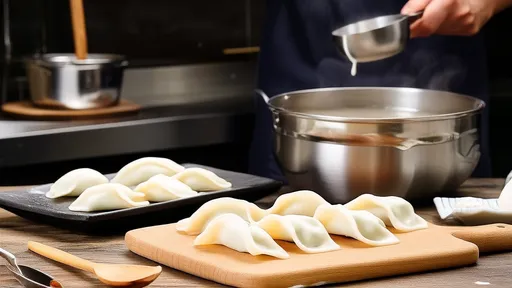
The culinary world is constantly evolving, with chefs and food scientists pushing the boundaries of traditional ingredients to create innovative dishes. One such breakthrough is the development of transparent dumpling wrappers using konjac flour, a technique that combines high-temperature sol formation with precise cooling processes. This method not only redefines the visual appeal of dumplings but also opens up new possibilities for gluten-free and low-calorie alternatives in Asian cuisine.
The Science Behind Konjac Flour
Konjac flour, derived from the root of the Amorphophallus konjac plant, has been a staple in Asian cooking for centuries. What makes it particularly suitable for transparent wrappers is its high glucomannan content – a water-soluble dietary fiber that forms viscous solutions when mixed with water. When subjected to heat, this mixture undergoes a remarkable transformation. The molecular chains of glucomannan unwind and bind with water molecules, creating a homogeneous sol that possesses both elasticity and plasticity. This unique property allows the sol to be shaped while maintaining structural integrity during the cooking process.
Crafting the Perfect Sol
The journey to transparent dumpling skins begins with achieving the perfect sol consistency. Artisans typically use a ratio of 1 part konjac flour to 20-30 parts water, depending on the desired thickness of the final product. The mixture is gradually heated to 80-90°C while being constantly stirred to prevent lump formation. At this critical temperature range, the glucomannan molecules fully hydrate and the solution transitions from milky white to translucent. Maintaining this temperature for 10-15 minutes ensures complete dissolution while preventing premature gelation that could compromise the wrapper's smooth texture.
The Art of Temperature Control
Precision temperature management separates successful transparent wrappers from failed attempts. As the sol reaches optimal viscosity, it's poured onto specially designed cooling trays. These trays often feature non-stick surfaces and precise thickness controls to ensure uniform wrapper formation. The cooling process must be carefully calibrated – too rapid cooling causes brittleness, while too slow cooling may result in excessive moisture loss. Professional kitchens often employ multi-stage cooling: an initial air-cooling phase to set the surface, followed by controlled refrigeration to complete the gelation process.
From Gel to Gourmet
The final gel possesses remarkable properties that challenge conventional dumpling wrappers. Unlike wheat-based skins that become opaque when cooked, the konjac wrapper remains crystal clear, showcasing the colorful fillings within. This transparency isn't merely aesthetic – it serves practical purposes in commercial food production. Chefs can visually inspect fillings for quality and distribution without compromising the wrapper's integrity. Moreover, the neutral taste and smooth mouthfeel of konjac wrappers allow the flavors of premium ingredients to shine through without competition from the wrapper itself.
Challenges in Commercial Production
Scaling this delicate process for mass production presents unique hurdles. Industrial manufacturers have developed specialized equipment to maintain the precise temperature gradients required throughout the production line. Some factories employ continuous casting machines that pour the sol onto moving cooling belts, while others use modular systems that allow for batch processing with strict environmental controls. The packaging process also requires innovation, as traditional vacuum sealing can deform the delicate wrappers. Many producers now use rigid containers with moisture-controlled atmospheres to preserve the product's quality during distribution.
Culinary Applications Beyond Dumplings
The implications of this technology extend far beyond traditional dumplings. Innovative chefs are adapting the technique to create transparent spring roll wrappers, translucent pasta sheets for modern interpretations of lasagna, and even clear dessert wraps for avant-garde pastries. The health food industry has embraced konjac wrappers as a vehicle for low-carb, high-fiber versions of beloved dishes. Some experimental bartenders have even used thin konjac films as edible cocktail garnishes that dissolve in drinks, releasing flavors in a visually striking manner.
Nutritional Advantages and Consumer Appeal
From a health perspective, konjac-based wrappers offer significant benefits over traditional options. They're naturally gluten-free, contain minimal digestible carbohydrates, and provide soluble fiber that may support digestive health. The low calorie count (approximately 5-10 calories per wrapper compared to 50-70 for wheat-based versions) makes them attractive to health-conscious consumers. However, the manufacturing process does require careful formulation to ensure adequate mineral content, as konjac flour alone doesn't provide the same nutritional profile as whole grain flours.
The Future of Transparent Food Technology
As food technology advances, we're likely to see further refinements in konjac processing techniques. Researchers are experimenting with hybrid formulations that combine konjac with other hydrocolloids to enhance mechanical strength or introduce functional properties like controlled flavor release. Some laboratories are exploring the potential of 3D printing with konjac sol to create intricate edible structures impossible to achieve through traditional methods. These developments suggest that what began as a novel way to make see-through dumplings may evolve into an entirely new category of culinary materials.
The creation of transparent dumpling wrappers represents more than just a technical achievement – it's a testament to how traditional ingredients can be reimagined through scientific understanding and precise craftsmanship. As this technology matures and becomes more accessible, we may find these crystal-clear delicacies transitioning from specialty restaurants to home kitchens, changing our visual and gustatory expectations of what dumplings can be.
By /Jun 18, 2025

By /Jun 18, 2025
By /Jun 18, 2025
By /Jun 18, 2025
By /Jun 18, 2025
By /Jun 18, 2025
By /Jun 18, 2025
By /Jun 18, 2025

By /Jun 18, 2025
By /Jun 18, 2025
By /Jun 18, 2025
By /Jun 18, 2025
By /Jun 18, 2025
By /Jun 18, 2025
By /Jun 18, 2025
By /Jun 18, 2025
By /Jun 18, 2025
