Working with ciabatta dough presents unique challenges due to its high hydration level, often exceeding 80%. The sticky, wet mass can intimidate even experienced bakers, but mastering the folding technique transforms this unruly dough into the airy, open-crumbed bread that defines authentic ciabatta. Unlike stiff doughs that tolerate rough handling, ciabatta demands a gentle touch and strategic folds to develop gluten without degassing precious bubbles.
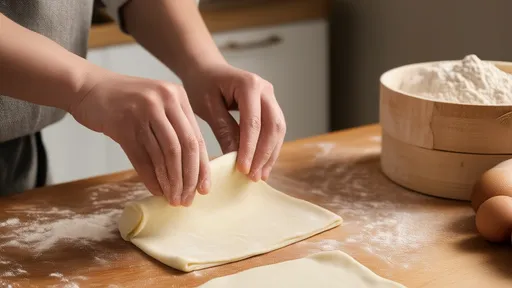
The initial mix resembles a shaggy batter more than traditional bread dough. After a brief autolyse rest, the first fold begins not with kneading but with wet hands scooping from beneath. The key lies in stretching the dough upward until resistance is felt, then laying it over itself in a business-letter fold. This motion is repeated at 30-minute intervals, with each session building strength while preserving those nascent alveoli. Bakers soon learn to read the dough’s surface – when it starts holding subtle finger indentations and develops a gossamer-like membrane beneath, the gluten network is reaching maturity.
Banneton selection proves equally critical for ciabatta’s final form. Traditional oval proofing baskets support the dough’s slipper shape, but their porous rattan requires meticulous preparation to prevent disastrous sticking. A 50/50 blend of rice flour and all-purpose flour creates the ideal non-stick coating, with the rice flour’s granular structure acting as microscopic ball bearings. Seasoning new bannetons involves multiple applications brushed into the crevices, followed by overnight drying – a process that builds up a release layer akin to cast iron’s patina.
During final proofing, the dough’s high hydration makes it particularly vulnerable to over-extension. Experienced bakers often employ a linen couche liner inside the banneton for extra support, its heavily floured folds cradling the dough like a hammock. The telltale sign of proper proofing emerges when the dough relaxes just enough to fill the basket’s contours without spreading laterally – typically 60-75 minutes at 75°F. Cold retardation can extend this window, but the dough’s delicate structure demands careful monitoring regardless of temperature.
The turning-out maneuver separates the artisans from the amateurs. A swift, confident flip onto parchment prevents the dough from suctioning to the basket, while hesitation guarantees a deflated loaf. Some bakers advocate a pre-turn tap test – if the basket releases a hollow sound when gently knocked, the dough has formed just enough skin to hold its shape. For particularly sticky batches, a light mist of water between basket and dough can create a helpful release layer, though this requires precise timing to avoid soggy spots.
Seasonal adjustments play an underappreciated role in ciabatta success. Humid summers may necessitate reducing hydration by 2-3%, while winter’s dry air could demand extra folds to compensate for slower gluten development. The dough’s temperature proves equally vital – maintaining it between 75-78°F ensures steady fermentation without excessive stickiness. Professional kitchens often keep proofing boxes at slightly higher humidity than for other breads, recognizing ciabatta’s unique vulnerability to surface drying during its prolonged rise.
Beyond technique lies the philosophical shift ciabatta demands – embracing rather than fighting the wetness. Where bakers instinctively reach for flour when dough sticks, ciabatta rewards those who wet their tools instead. The dough scraper becomes an extension of the hand when dipped in water, gliding beneath the mass to facilitate folds. Countertops need only the lightest dusting, if any, as excess flour creates undesirable dry patches in the final crumb. This counterintuitive approach extends to scoring; most ciabatta benefits from minimal or no scoring, allowing the crust to rupture organically along its weakest points during oven spring.
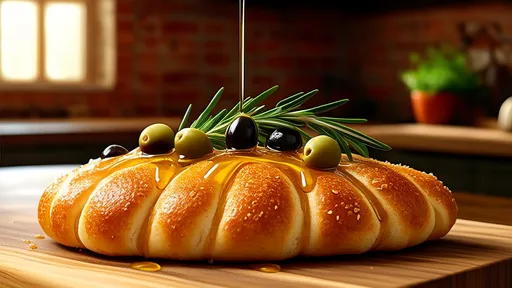
Post-bake evaluation reveals whether folding and proofing techniques succeeded. Perfectly handled ciabatta exhibits irregular bubbles ranging from pinhead to inch-wide, with the crust displaying a mosaic of crisp and chewy textures. The base should show the barest impression of the banneton’s spiral pattern – enough to prove proper release but not so deep as to indicate sticking. Those who master these nuances discover why professional bakers consider ciabatta the ultimate test of touch: a bread that can’t be bullied into submission, only coaxed into excellence.
By /Jun 18, 2025
By /Jun 18, 2025
By /Jun 18, 2025

By /Jun 18, 2025
By /Jun 18, 2025
By /Jun 18, 2025
By /Jun 18, 2025
By /Jun 18, 2025

By /Jun 18, 2025
By /Jun 18, 2025

By /Jun 18, 2025
By /Jun 18, 2025

By /Jun 18, 2025
By /Jun 18, 2025
By /Jun 18, 2025
By /Jun 18, 2025
By /Jun 18, 2025
